
Why Faith-Conscious Consumers Are Rethinking Their Supplements
The global wellness movement has taken a meaningful turn, and millions of health-conscious consumers are now looking beyond just ingredients — they are also looking at values. For Muslim communities and ethical shoppers worldwide, what goes into a supplement matters just as much as what it does. Halal vitamins — certified supplements free from forbidden ingredients — are no longer a niche product but a mainstream demand shaping the entire supplement industry.
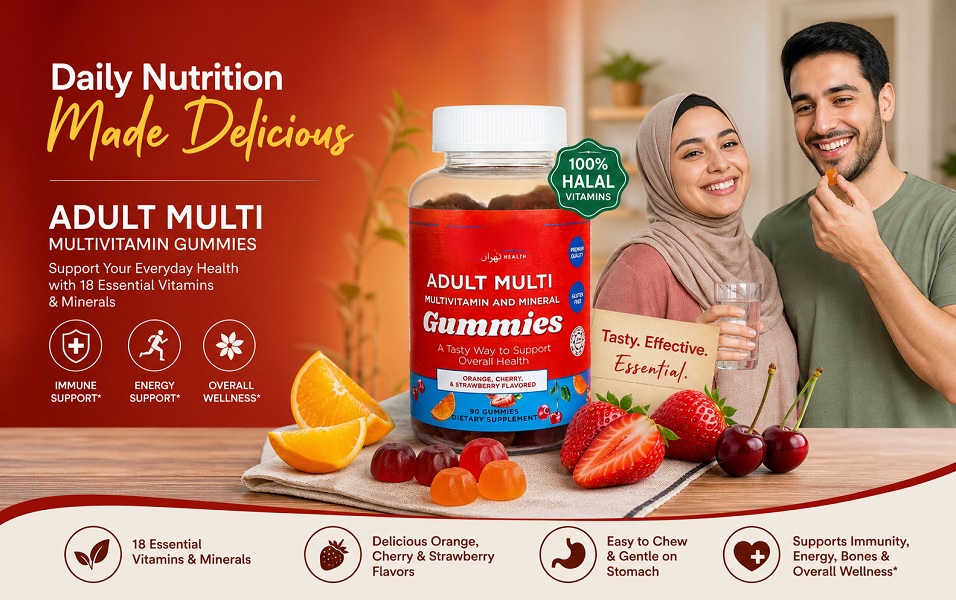
Whether you are a parent choosing vitamins for your family, an athlete seeking clean nutrition, or simply someone who wants transparency in their daily wellness routine, products like the Adult Multivitamin Gummies from Nahraan Health represent exactly where the supplement world is heading.
The Global Market Is Exploding — and Here’s Why
The numbers tell a powerful story. The global halal nutraceuticals market was valued at $58 billion in 2021 and is projected to reach $116 billion by 2031, effectively doubling in just one decade. This extraordinary growth is being driven by a combination of factors: the world’s 1.8 billion Muslim consumers demanding faith-compliant health products, a post-pandemic surge in immune health awareness, and a broader non-Muslim audience drawn to the clean-label, ethically sourced promise of certified supplements.
What makes this growth especially impressive is that it is not limited to any single region. North America, Europe, Southeast Asia, and the Middle East are all seeing significant upticks in demand. Consumers in countries like the United States, Canada, the United Kingdom, and Malaysia are actively searching for supplements that meet halal standards — not just for religious compliance, but because halal certification has become a trusted proxy for ingredient quality and manufacturing transparency.
What Makes a Vitamin Truly Halal?
Not all vitamins are created equal, and the halal certification process ensures that every step of production meets strict Islamic dietary law. A supplement earns halal certification only when it is completely free from porcine gelatin, alcohol-based additives, and any cross-contamination with haram (forbidden) substances during manufacturing. This is a higher bar than most standard supplement certifications require.
Traditionally, gummy vitamins were off-limits for halal consumers because of the widespread use of porcine gelatin as a binding agent. Technological innovation changed that. Today, premium brands use fruit-derived pectin as the gold-standard binder — making gummies both halal and vegan-friendly. Similarly, Vitamin D3, which is commonly sourced from lanolin (sheep wool) or fish, is now available in plant-based forms derived from algae or lichen, satisfying halal requirements while also appealing to vegetarian consumers.
The manufacturing environment matters too. Reputable halal-certified labs operate under Good Manufacturing Practices (GMP), are FDA-certified, and maintain rigorous standards against any cross-contamination with non-halal materials. Certifications from recognized bodies like ISA (Islamic Society of Agriculture) or ISNA add an important layer of third-party verification that consumers can trust.
Halal Vitamins Are for Everyone, Not Just Muslims
One of the biggest misconceptions in the supplement market is that halal vitamins are only relevant to Muslim consumers. In reality, the clean, ethical standards behind halal certification appeal to a much wider audience. Vegans and vegetarians benefit because halal-certified gummies typically use plant-based binders like pectin instead of animal-derived gelatin. Health purists appreciate the absence of artificial colors, synthetic preservatives, and questionable additives.
Parents especially are drawn to halal-certified children’s vitamins because the certification guarantees purity and safety at every level of production. When you see a halal certification on an adult multivitamin gummy bottle, you know the product has been scrutinized not just for efficacy but for the integrity of every single ingredient — from the vitamin source down to the coating and coloring agents. This universal appeal is exactly why many non-Muslim-majority countries are seeing rapid growth in halal supplement sales.
Nahraan Health: Setting the Standard for Halal Supplements
Among the brands leading this movement, Nahraan Health stands out as a trusted name for Muslim families and health-conscious consumers seeking certified products. Their Adult Multivitamin Gummies exemplify what a modern halal supplement should look like: ISA Halal Certified, produced in an FDA-certified facility, manufactured under GMP protocols, gluten-free, GMO-free, and vegetarian.
What distinguishes Nahraan Health is also the community-first philosophy behind the brand. Operated by community pharmacists with over 40 years of combined experience, the company understands that supplements are not just about nutrients — they are about trust.
Every product in their range, from kids’ multivitamin gummies to omega DHA gummies, is designed to meet the health needs of diverse families without ever compromising on faith-based standards. For consumers who have struggled to find supplements they can confidently take every day, Nahraan Health removes that barrier entirely.
The Ingredient Revolution Powering Halal Supplement Innovation
The rise of halal vitamins has accelerated a broader ingredient innovation movement across the supplement industry. Manufacturers seeking halal certification are being pushed to find cleaner, more ethical, and more sustainable sources for common supplement ingredients — and the results benefit all consumers.
Plant-based omega-3 derived from algae is replacing fish oil, eliminating not just halal concerns but also environmental ones. Fermentation-based vitamins are replacing animal-sourced alternatives, producing purer, more bioavailable nutrients. Natural fruit-based colorings are replacing synthetic dyes linked to health concerns. Even capsule technology has evolved — vegetable cellulose capsules now replace the traditional gelatin capsules that once made many supplements inaccessible to halal consumers.
Blockchain-based supply chain tracking is the next frontier. Forward-thinking companies are beginning to use digital ledgers to provide end-to-end transparency — from raw ingredient sourcing to the finished product on your shelf. This level of accountability aligns perfectly with what halal certification demands and what modern consumers increasingly expect.
Addressing the Hidden Haram in Everyday Supplements
Millions of consumers unknowingly consume haram (forbidden) ingredients in their daily supplements. The hidden sources are often surprising: standard gummy vitamins use porcine-derived gelatin; many softgel capsules are made from pig skin or beef from non-halal-slaughtered animals; certain vitamins like D3 are derived from non-halal animal products; and some liquid supplements contain trace amounts of alcohol as a preservative or carrier.
This is why simply assuming a supplement is “safe” is not enough — especially for those who observe halal dietary laws. Halal vitamins solve this problem comprehensively. A certified product has been audited to ensure no haram ingredient appears at any stage of its formulation, sourcing, or manufacturing. Labels like “gelatin-free,” “alcohol-free,” and “ISA Halal Certified” are not just marketing terms — they are backed by rigorous third-party inspections and ongoing compliance reviews.
For consumers who have experienced the frustration of reading ingredient labels only to find ambiguous terms like “gelatin” or “natural flavors” without clarification, switching to halal-certified supplements eliminates that uncertainty entirely.
Smart Shopping: How to Choose the Right Halal Supplement
Navigating the supplement aisle — physical or digital — can be overwhelming, especially when halal labeling is not always standardized. Here is what to look for when choosing a halal-certified vitamin:
- Look for a recognized halal certification body on the label, such as ISA, ISNA, IFANCA, or a regional equivalent, not just a brand’s self-declaration
- Check the gelatin source — fruit pectin or plant-based alternatives are ideal; beef gelatin is acceptable only if from a halal-slaughtered source with proper certification
- Review the Vitamin D source — ensure it is plant-derived (from algae or lichen) or confirmed halal-animal sourced
- Verify GMP and FDA-certified manufacturing — this confirms the facility upholds quality and safety standards beyond just halal compliance
- Avoid supplements with “natural flavors” without clarification — this ambiguous term can hide animal-derived ingredients
- Choose brands with transparent supply chains — companies that openly display their certifications and testing reports demonstrate genuine commitment to halal standards
Nahraan Health’s Adult Multivitamin Gummies check every single one of these boxes — making them one of the most straightforward choices for consumers who refuse to compromise on either health or values.
The Road Ahead: Personalization, Technology, and Faith-Driven Wellness
The future of halal vitamins is not just about meeting compliance standards — it is about innovation that puts the consumer first. Nutrigenomics, the science of tailoring nutritional supplementation to an individual’s genetic makeup, is set to transform the supplement industry, and halal-certified personalized vitamins are already on the horizon. AI-driven health platforms will soon recommend customized halal supplement stacks based on your DNA, lifestyle, and specific health goals.
At the same time, the growing overlap between halal, vegan, clean-label, and organic markets means that halal supplement brands are finding new audiences they never anticipated. As consumers globally move toward ethical, transparent, and ingredient-conscious purchasing, the values embedded in halal certification are resonating beyond faith communities.
The supplement industry is witnessing a rare moment: a product category where religious compliance, ethical sourcing, clean nutrition, and superior quality all converge. For anyone serious about their health and values, halal vitamins are not a passing trend — they are the standard that the entire industry is being measured against.